

Summary
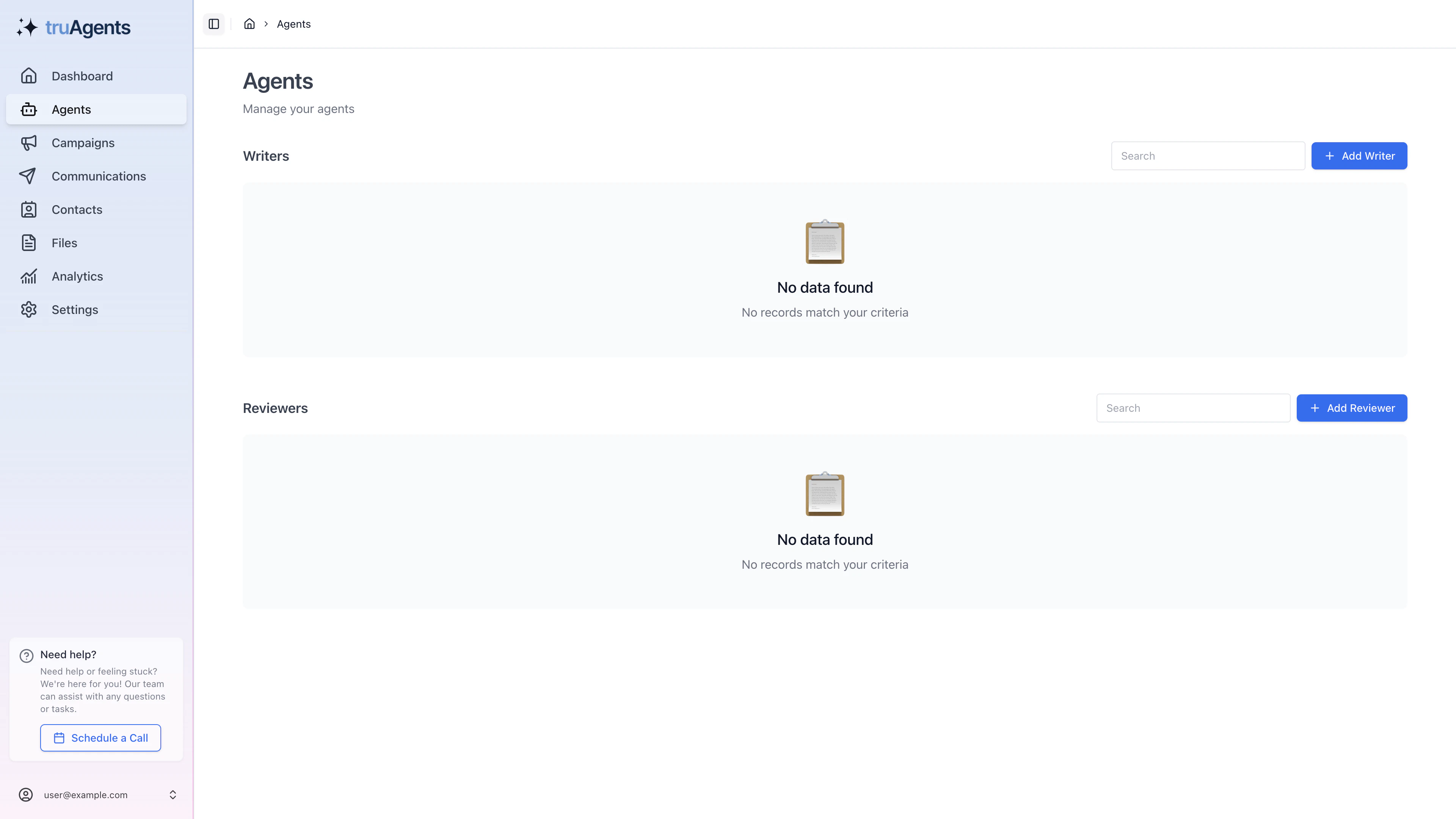
Agents are one of the core TruAgents building blocks. In the current product flow, the most visible agent types for end users are writers and reviewers. Your first agent setup should focus on creating something usable for a real campaign, not on modeling every possible variation upfront.Who this is for
- New customers configuring their first AI-assisted workflow
- Admins and operators defining reusable campaign behavior
- Internal teammates helping a customer move from setup into execution
Where to find it in the app
- Agents
- Agent Writers
- Agent Reviewers
Recommended first setup approach
Start with a writer
The writer is the most direct path to getting campaign content generation working. It is the easiest place to prove that your instructions, model choice, and overall communications style are pointing in the right direction.Add a reviewer when you need guardrails
Reviewers become more important as you need stronger approval logic, quality control, or risk reduction before communications go out at scale.Decision guide for the first agent
What the current app suggests matters
From the app structure, the first-pass user concerns appear to be:- agent name and identity
- model selection for users who can access it
- specialty or template alignment
- campaign reuse across multiple campaigns
Recommended first-agent pattern
- Create one writer with a clear title and purpose.
- Keep the instructions matched to the kind of campaign you plan to test first.
- Avoid creating multiple overlapping agents before you trust the first one.
- Add a reviewer only when the team needs stronger guardrails than draft review alone provides.
Example: good first writer
A strong first writer usually has:- a name another teammate can understand quickly
- instructions matched to one clear outreach style
- enough structure to be reusable
- no unnecessary complexity that makes failures harder to diagnose
Signs the first agent is too complicated
- the team cannot explain what makes one agent different from another
- campaign setup becomes a debate about agent nuance before the first run exists
- instructions mix together multiple use cases that should have been separated later
Success checklist
- At least one usable writer exists.
- The team understands when a reviewer is also required.
- The agent can be selected during campaign creation.
- The first campaign setup does not depend on undocumented internal defaults.
What we should document in more detail later
- How to choose between starter and custom configurations
- How agent instructions differ from campaign instructions
- How to think about specialties, models, templates, and voice settings
- How admin-only controls differ from general user-facing controls